 Gemini 4 Neon
Nano Banana 2.1 vs Nano Banana Pro: Which Should You Use?
Price per image at 1K, 2K and 4K, the API parameters only one model accepts, and what our same-prompt test on APIKO showed. Where Pro still earns its place.
このページの内容
Short answer
Nano Banana 2.1 vs Nano Banana Pro: start new image work on 2.1. At list price it costs a quarter to half as much per image and ranks above Pro in Arena's early blind votes. Every finished image from both models had English and Chinese text exact in our tests. Keep Pro for five-character scenes, style references and jobs that fail review on 2.1.
This post is for developers choosing an image model for an API workload. Disclosure: APIKO is our own gateway and sells both models. Google facts come from Google's Gemini API pages, rankings from Arena's public leaderboards, and gateway results come from 35 requests we sent through APIKO on October 8, 2026.
Nano Banana 2.1 (gemini-nano-banana-2.1) went generally available on October 6, 2026 as the update to Nano Banana 2. Nano Banana Pro (gemini-3-pro-image) shipped as a preview in November 2025 and went GA on May 28, 2026. They are two tiers Google sells side by side, so the question is which tier a workload needs. Every image model APIKO serves is on /models.
Nano Banana 2.1 vs Nano Banana Pro at a glance
| Your situation | Use | Why |
|---|---|---|
| New image feature, no baseline yet | Nano Banana 2.1 | Google recommends it over Nano Banana 2 for new projects; lowest list price per image |
| High-volume thumbnails, social posts, product variants at 1K | Nano Banana 2.1 | One quarter of Pro's list price at 1K |
| Tall formats or panoramas (1:4, 4:1, 1:8, 8:1) | Nano Banana 2.1 | Pro does not offer these ratios; on APIKO it also rejects 4:5 and 5:4 |
| Images that need real reference photos from the web | Nano Banana 2.1 | Only 2.1 can ground on Google Image Search |
| Five recurring characters, or style references | Nano Banana Pro | 5 character slots and 3 style slots, vs 4 and none on 2.1 |
| Pro output already passes brand review | Keep Pro, test 2.1 in parallel | Switch only after 2.1 passes the same review |
| Running Nano Banana 2 | Move to Nano Banana 2.1 | Google deprecated Nano Banana 2 on October 6, 2026 |
Nano Banana 2.1 vs Pro: specs and parameters
Nano Banana 2.1 is the more configurable model: more aspect ratios, more reference images, video and PDF input, adjustable thinking, and Image Search. Pro has the larger character and style budget. Everything in this table comes from Google's model pages (2.1, Pro), image generation guide and pricing page.
| Nano Banana 2.1 | Nano Banana Pro | |
|---|---|---|
| Model ID (Gemini API) | gemini-nano-banana-2.1 | gemini-3-pro-image |
| Status | Stable, GA October 6, 2026 | Stable, GA May 28, 2026 |
| Google's positioning | "Primary high-efficiency workhorse" | "Premium choice for the most complex visual tasks" |
| Output sizes | 1K, 2K, 4K (default 1K) | 1K, 2K, 4K (default 1K) |
| Aspect ratios | 14, adding 1:4, 4:1, 1:8, 8:1 | 10, including 4:5 and 5:4 (8 on APIKO) |
| Reference images | Up to 14: 10 objects, 4 characters | Up to 14: 6 objects, 5 characters, 3 style |
| Inputs | Text, image, video, PDF | Text, image |
| Input token limit | 131,072 | 65,536 |
| Thinking | Always on; minimal, medium (default), high | Always on; not adjustable |
| Search grounding | Web and Image Search | Web Search |
| Batch API | Yes | Yes |
Google's changelog lists what 2.1 improved over Nano Banana 2: visual quality, prompt adherence, multi-turn character consistency, text rendering, and wide and panoramic ratios. The model page adds a fix for tiling artifacts on those panoramic ratios at 2K and 4K. Google publishes no head-to-head scores against Pro. Independent blind voting does: on the Arena text-to-image leaderboard (October 6, 2026), Nano Banana 2.1 ranks 5th with a score of 1,328, against 1,248 and 16th place for Nano Banana Pro at 2K. On the image edit leaderboard it ranks 6th with 1,428, against 1,390 and 12th for Pro.
The confidence intervals do not overlap on either board, but read those as an early signal. 2.1's scores come from 5,312 and 12,985 votes in its first days, against hundreds of thousands for Pro, and Arena measures general preference on varied prompts, not exact text or brand consistency. Test your own prompts before moving work.
Nano Banana 2.1 price vs Pro, per image
At Google's list prices, Nano Banana 2.1 is 75% cheaper than Pro at 1K, 62% cheaper at 2K and 53% cheaper at 4K. On APIKO the gap is much smaller: 16% at 1K and under 2% at 4K.
Google prices image output in tokens and converts it to a per-image price. The rows below are Standard tier as of October 8, 2026; APIKO's rates are from the Nano Banana 2.1 and Nano Banana Pro pages as of October 26, 2026.
| Per image | Nano Banana 2.1, Google | Nano Banana Pro, Google | Nano Banana 2.1, APIKO | Nano Banana Pro, APIKO |
|---|---|---|---|---|
| 1K | $0.0336 | $0.134 | $0.0142 | $0.0168 |
| 2K | $0.0504 | $0.134 | $0.0157 | $0.0180 |
| 4K | $0.113 | $0.24 | $0.0189 | $0.0192 |
| Batch tier, 1K / 4K | $0.0168 / $0.0567 | $0.067 / $0.12 | Not offered | Not offered |

Three details change the real bill on Google's API:
- The per-image price is output only. Prompt and reference images are billed as input ($1.50 per million tokens on 2.1, $2.00 on Pro), and thinking tokens as text output ($7.50 and $12.00 per million). Thinking is always on for both, so every request carries some.
- Pro's 2K costs the same as its 1K. Both use 1,120 output tokens on Pro, so at list price there is no reason to order Pro at 1K. On 2.1, 2K uses 1,680 tokens and costs 50% more.
- Search grounding is metered. 5,000 grounded requests a month are free across Gemini 3.x models, then $14 per 1,000.
Watch the 4K figure for 2.1. Google's image generation guide still lists a 4K image at 2,520 tokens, which works out to $0.0756, and several launch-week articles quote that number. The pricing page, updated October 7, says 3,780 tokens and $0.113. Budget with the pricing page.
APIKO bills per image only, with no separate input, thinking or search charges. Rates change, so check /pricing before you budget.
Applied to three monthly workloads, the difference looks like this. It is price arithmetic, not a measurement, and leaves out Google's input, thinking and search charges. APIKO columns use unrounded per-image rates.
| Monthly workload | 2.1, Google | Pro, Google | 2.1, APIKO | Pro, APIKO |
|---|---|---|---|---|
| A. 10,000 social images at 1K | $336.00 | $1,340.00 | $141.74 | $167.98 |
| B. 2,000 product shots at 2K | $100.80 | $268.00 | $31.50 | $36.00 |
| C. 500 hero banners at 4K | $56.50 | $120.00 | $9.45 | $9.60 |
At list price, moving workload A from Pro to 2.1 saves about $1,000 a month, which is why most teams will default to 2.1. On APIKO the same move saves $26 on workload A and $0.15 on workload C, so pick the model on output quality.
Nano Banana 2.1 API vs Pro: what breaks on APIKO
Both models use the same endpoints on APIKO: POST /v1/images/generations, POST /v1/images/edits and GET /v1/tasks/{id}, with the same prompt, size, resolution, images and async fields. Moving a request from Pro to 2.1 is a model-string change. Every Pro request we could build is also valid for 2.1.
The other direction breaks. Nano Banana 2.1 accepts parameters Pro does not, and APIKO rejects them with a 400 before the job runs, so nothing is charged. We sent each rejected case once on October 8, 2026. The "Accepted" cells come from APIKO's /v1/models parameter list; 4:5, 8:1 and two thinking levels also ran in the test below.
| Request | nano-banana-2.1 on APIKO | nano-banana-pro on APIKO | Pro on Google's API |
|---|---|---|---|
thinking_level: minimal / medium / high | Accepted | 400 thinking_level is not supported | Not adjustable |
web_search: true or image_search: true | Accepted, no extra charge | 400 web_search is not supported (same for image_search) | Web Search yes, Image Search no |
size: auto, 4:5, 5:4, 1:4, 4:1, 1:8, 8:1 | Accepted | 400 size must be one of: 1:1, 16:9, 9:16, 4:3, 3:4, 3:2, 2:3, 21:9 | 4:5 and 5:4 yes; 1:4 to 8:1 no |
10 to 14 reference URLs in images | Accepted up to 14 | 400 images must contain 1 to 9 HTTPS URLs | Up to 14 |
resolution: "512" | 400 resolution must be one of: 1k, 2k, 4k | Same | Not offered |
n: 2 | 400 n must be 1 | Same | Not covered here |
Where the last column says yes, the 400 is an APIKO limit, not Google's: APIKO accepts eight ratios and up to 9 references for Pro and does not pass Search grounding through. If you need any of these on Pro, call Google directly; gateway vs direct integration covers when that trade-off is worth it.
So if Pro is your rollback route, keep a version of each request without the 2.1-only fields:
  {
-   "model": "nano-banana-2.1",
+   "model": "nano-banana-pro",
    "prompt": "...",
-   "size": "4:5",
+   "size": "3:4",
    "resolution": "2k",
-   "thinking_level": "high",
-   "image_search": true,
    "async": true
  }
Use "async": true for both models. A synchronous request holds the connection open until the image is ready, and APIKO's edge closes it with a 524 when no response arrives within about 100 seconds. APIKO's docs say the request is still charged and no task id comes back, so the image is lost. Our first synchronous 1K request to Nano Banana 2.1 got that 524 (126 seconds by our client's clock), which is why everything below runs async.
This is the request we used, with polling:
import time
import requests

BASE = "https://api.apiko.app/v1"
HEADERS = {"Authorization": "Bearer YOUR_APIKO_KEY"}


def generate(body):
    task = requests.post(f"{BASE}/images/generations", headers=HEADERS,
                         json={**body, "async": True}, timeout=30).json()
    while True:
        time.sleep(5)
        res = requests.get(f"{BASE}/tasks/{task['id']}", headers=HEADERS, timeout=30).json()
        if res["status"] in ("completed", "failed"):
            return res


res = generate({
    "model": "nano-banana-2.1",
    "prompt": 'A printed cafe menu card titled "HARBOR BEANS" on a wooden table',
    "size": "4:5",
    "resolution": "2k",
    "thinking_level": "minimal",
})
print(res["status"], res["data"][0]["url"] if res["status"] == "completed" else res)
Result links are signed and kept for 24 hours, so download anything you want to keep. The Nano Banana 2.1 API reference lists every field.
Our same-prompt test on APIKO
On October 8, 2026 we sent the same prompts to both models through APIKO's async API, in two rounds. Round one: a cafe menu card with five exact lines of text, an edit of Pro's first result (the same input image for both models), a 4K banner, and two ratios APIKO accepts only on 2.1. Round two, three runs per model: a poster with small print at 2K, and a Simplified Chinese menu board at 1K. That is 23 images and one failed task, plus the 10 rejected requests above and the one synchronous request that timed out.
We judged text by comparing every line character by character with the prompt, and edits by whether any word on the card changed. The menu card prompt, verbatim:
A flat lay photo of a printed cafe menu card on a wooden table. The card reads, exactly: title "HARBOR BEANS", then three lines "Flat White $4.50", "Cold Brew $5.25", "Cardamom Bun $3.75", and a footer "Open daily 7am - 3pm". Natural window light.
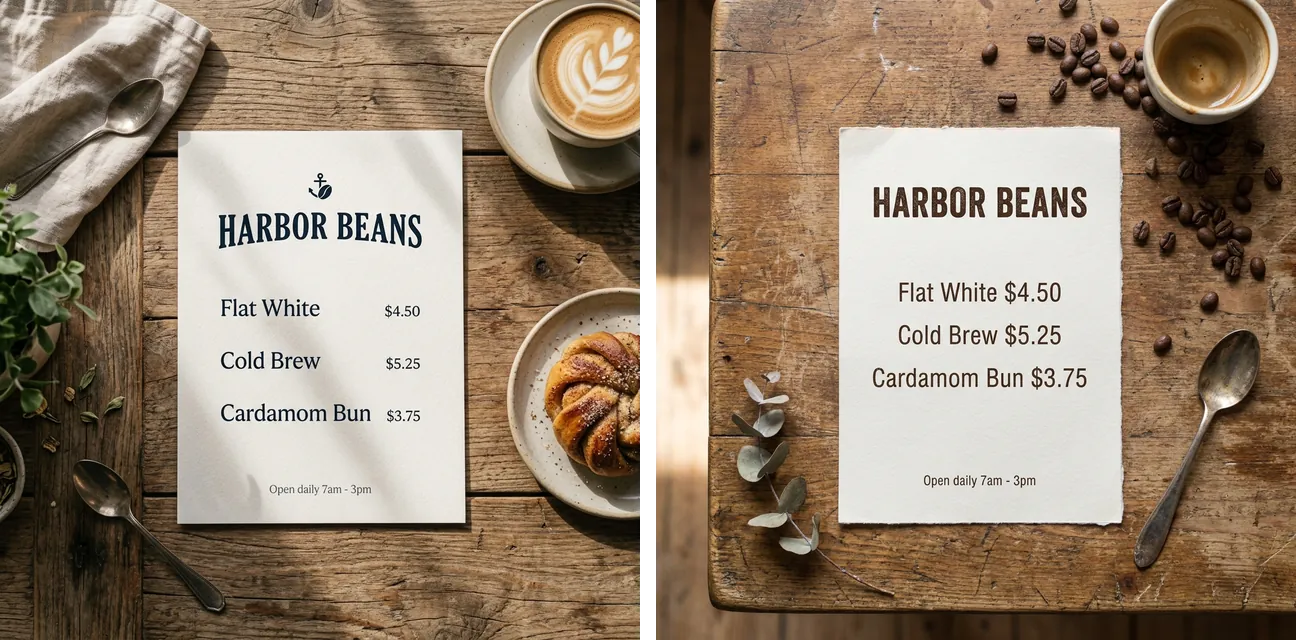
Left: Nano Banana 2.1. Right: Nano Banana Pro. Both at 1K with default settings, first run.
| Case | Nano Banana 2.1 | Nano Banana Pro |
|---|---|---|
| Menu card, 1K, default settings, 2 runs each | All five lines exact in both runs | All five lines exact in both runs |
| Poster with small print, 2K, 3 runs each | 2 of 2 finished runs exact; 1 task failed after 209 s | All lines exact in 3 of 3 |
| Simplified Chinese menu board, 1K, 3 runs each | All characters exact in 3 of 3 | All characters exact in 3 of 3 |
Menu card at thinking_level minimal and high | Exact at both levels | Not adjustable |
| Edit of Pro's first image: "Keep the menu card and every word on it unchanged. Replace the wooden table with grey marble and add a latte beside the card." | Text unchanged; replaced the espresso cup with a latte | Text unchanged; kept the espresso and added a latte |
| 4K, 16:9 | 5504×3072 JPEG, 8.4 MB | 5504×3072 PNG, 19.0 MB |
| 8:1 at 2K | 5856×704, no visible seams | Not offered by Google; 400 on APIKO |
| 4:5 at 2K (the code example above) | 1856×2304 | Rejected on APIKO (400) |
| File format, every run | JPEG | PNG |
| Submit to finished task | 47 to 157 seconds; one task failed at 209 s | 40 to 156 seconds |
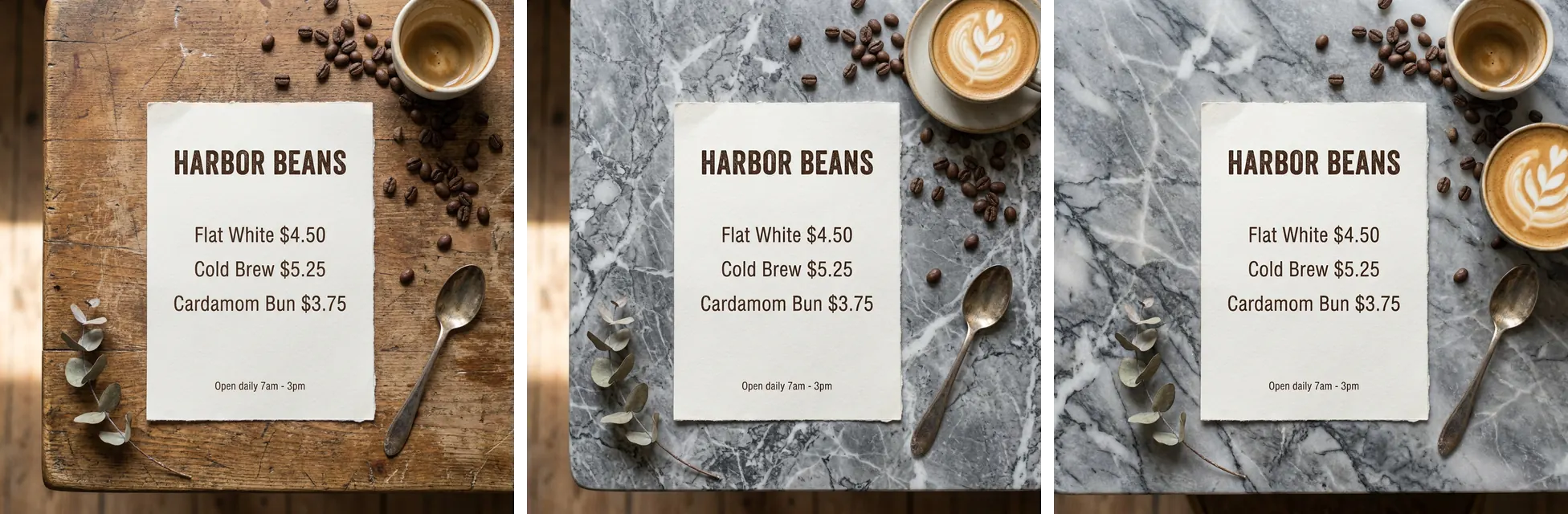
Left: the input image. Middle: Nano Banana 2.1's edit. Right: Nano Banana Pro's edit.

Nano Banana 2.1 at 8:1 and 2K, shown downscaled (open a larger copy). Prompt: "A panoramic city skyline at dusk along a river, warm windows, no text."

The round-two prompts, verbatim:
A printed A4 event poster pinned to a cork board. It reads, exactly: headline "API WEEK", subheading "Three days of talks for developers", then three schedule lines "Tue 14 Oct Gateways and routing", "Wed 15 Oct Image models in production", "Thu 16 Oct Cost control workshop", a footer in small print "Free entry. Register at example.com/events by 10 Oct.", and a corner badge "120 seats".
A photo of a tea shop menu board on a wooden wall. The board reads, exactly, in Simplified Chinese: title "山间茶舍", then three lines "龙井 28元", "普洱 32元", "桂花乌龙 30元", and a footer "每日 9:00 - 21:00 营业". Warm indoor light.
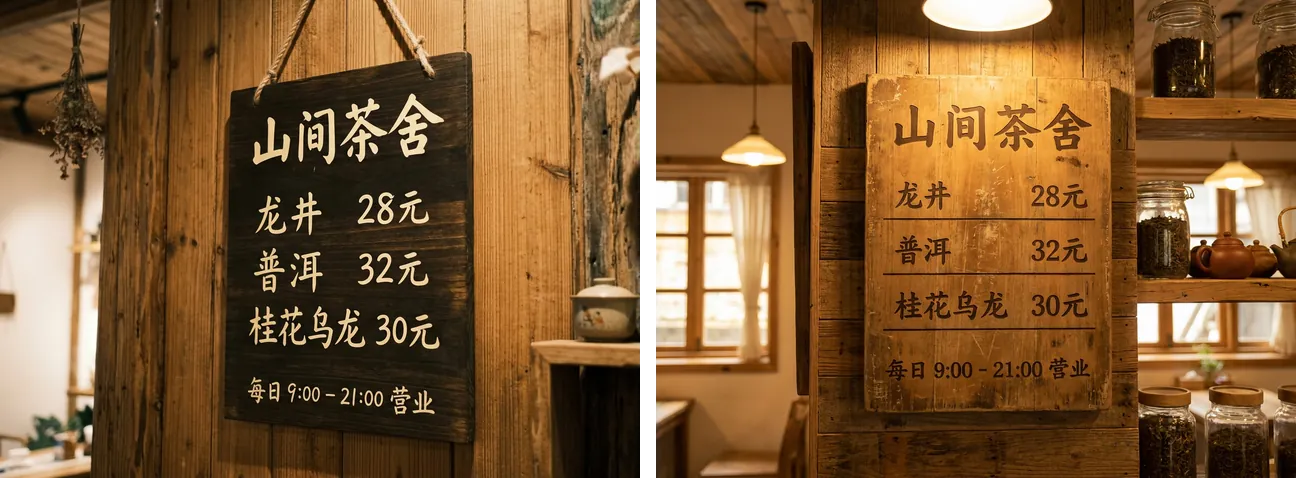
Left: Nano Banana 2.1. Right: Nano Banana Pro. Both at 1K, first run.
What we take from it, with one to three runs per case:
- Text rendering was a tie, including small print and Chinese. Every finished image from both models had every line exact: 9 of 9 for Nano Banana 2.1 and 8 of 8 for Pro, across English, small print and Simplified Chinese. Google's "advanced localization" claim for Pro did not show up as fewer errors here; longer copy, dense layouts and other scripts may still separate them, so test your own.
- Plan for an occasional failed task. One of ten text tasks on Nano Banana 2.1 ended
failedwithimage generation failedafter 209 seconds and no image; Pro had none in eight. A single failure gives no rate; make your client retry onfailed. - Pro followed the edit more literally. Asked to add a latte, Pro added one next to the existing cup, while 2.1 swapped the existing cup for it. Both kept every word on the card. It was a single edit, so add this check to your review set.
- Plan storage for PNG on Pro. Every Pro result came back as PNG and every 2.1 result as JPEG. At 4K that was 19.0 MB against 8.4 MB per image, which matters if you store or re-serve thousands of them.
- Wait times overlapped. Finished tasks took 40 to 157 seconds across both models, and
minimalthinking was not faster thanhigh(117 vs 47 seconds); measure on your own traffic. - Check exact pixel sizes on panoramic ratios. Our 8:1 image at 2K came back 5856×704, not the 6144×768 in Google's table. The 16:9 and 4:5 sizes matched exactly.
From our log, a typical line: pano_8x1_2k_nano-banana-2.1, status 200, 53.07 s, 5856×704. These are the images that came back through APIKO's current upstream route on one day. They show that both models handle this kind of task; your own prompts decide which one wins.
When should you keep Nano Banana Pro?
- Your scenes have five recurring characters. Pro takes five character references; 2.1 takes four.
- You steer style with reference images. Pro has three style-reference slots; Google lists none for 2.1.
- Pro output already passes brand or legal review, and 2.1 has not yet. Google's own wording gives Pro "accurate brand consistency"; that is a claim to verify before you switch.
- You need web Search grounding with Pro. Google offers it, but APIKO does not pass it through today; call Google directly, or test 2.1 with
web_search.
Nano Banana 2.1 vs Nano Banana Pro migration: a plan you can undo
- Freeze a review set. Take 20 to 50 real prompts per job type from your Pro or Nano Banana 2 traffic, with the reference images and the review criteria your team already uses.
- Strip the request to the shared fields. Keep
prompt,size,resolution,imagesandasync, and use a ratio both models accept. Then the only difference between runs is the model string. - Run 2.1 at two thinking levels. Try the default (
medium) andminimal. Keep the cheapest level that passes; on APIKO the price is the same, so pick on quality and wait time. - Switch one job type at a time. Start with the highest-volume, least sensitive type, such as thumbnails. Leave character-heavy and brand-critical jobs on Pro until they pass the same review.
- Keep the way back one line long. On APIKO the model is a field in the request, with the same key and endpoint. Remove the 2.1-only fields from the rollback version as shown above.
Before changing production code, run your hardest prompt in the playground on the Nano Banana 2.1 and Nano Banana Pro pages. If you are wiring a new client, the unified API quickstart covers the key and base URL.
Try it on APIKO
Still weighing Nano Banana 2.1 vs Nano Banana Pro for your workload? Both run behind one APIKO key on the same endpoints, so a side-by-side test is two requests. New accounts that sign in with Google using a Gmail address get $0.20 free to spend on every model, including Nano Banana 2.1 and Nano Banana Pro.
Try Nano Banana 2.1Sources
- Google: Gemini Nano Banana 2.1 model page
- Google: Gemini 3 Pro Image model page
- Google: Image generation guide
- Google: Gemini API pricing
- Google: Gemini API changelog
- Google: Gemini API deprecations
- Arena: Text-to-Image leaderboard
- Arena: Image Edit leaderboard
- APIKO: Nano Banana 2.1 API reference
- APIKO: Nano Banana Pro API reference
Google facts last verified October 8, 2026. Arena scores read October 8, 2026 from leaderboards dated October 6. APIKO gateway behavior verified October 8, 2026; APIKO prices verified October 26, 2026. Cost tables are price arithmetic on output images only.
よくある質問
Is Nano Banana 2.1 better than Nano Banana Pro?
On early blind votes, yes: Arena’s leaderboards (October 6, 2026) rank Nano Banana 2.1 above Nano Banana Pro for both generation and editing, on 5,312 and 12,985 votes so far, against hundreds of thousands for Pro. In our tests every finished image from both models had English and Chinese text exact. Pro still leads on references, with 5 character slots to 4 and 3 style slots to none, so run your own prompts on both before moving work that passed review on Pro.
How much does Nano Banana 2.1 cost per image?
On Google’s Gemini API, $0.0336 at 1K, $0.0504 at 2K and $0.113 at 4K (Standard tier, as of October 8, 2026), plus input and thinking tokens. Batch halves those rates. On APIKO it is $0.0142, $0.0157 and $0.0189 per image (as of October 26, 2026), with thinking and search included. Check /pricing for current rates.
Does Nano Banana 2.1 replace Nano Banana Pro?
No. Nano Banana 2.1 replaces Nano Banana 2 (gemini-3.1-flash-image), which Google deprecated on October 6, 2026 without a shutdown date. Google lists Nano Banana Pro (gemini-3-pro-image) as a stable model with no shutdown date and describes 2.1 as its more efficient counterpart.
What is the best version of Nano Banana right now?
For most API workloads, Nano Banana 2.1: Google recommends it over Nano Banana 2 for new projects, it has 14 aspect ratios to Pro’s 10, and it costs a quarter to half of Pro’s list price. Nano Banana Pro remains the premium option for work that needs five consistent characters, style references or what Google calls “accurate brand consistency”.
Should I still use Nano Banana 2?
Only until you have migrated. Google recommends moving new projects from Nano Banana 2 to 2.1 and has deprecated Nano Banana 2, with no shutdown date yet. On Google’s API, Nano Banana 2 still offers a 512px output size that 2.1 does not. On APIKO it is still listed, and at 4K it costs $0.0168 per image against $0.0189 for 2.1 (as of October 26, 2026).
Can Nano Banana Pro use Google Search?
On Google’s API, yes: Pro supports Grounding with Google Search (web results). Image Search grounding is only available on Nano Banana 2.1 and Nano Banana 2. On APIKO, web_search and image_search are only accepted for nano-banana-2.1; Pro returns a 400.
Do thinking and search cost extra?
On Google’s API, thinking tokens are billed as text output ($7.50 per million on 2.1, $12 on Pro), and search grounding is free for 5,000 requests a month across Gemini 3.x models, then $14 per 1,000. On APIKO, Nano Banana 2.1 is billed per image only; thinking_level, web_search and image_search add nothing.